


Temperatures in the UK have exceeded 30C for the 13th day in a row, the Met Office said.
Forecasters said 31.0C was recorded at Ross-on-Wye in Herefordshire on Friday.
However, the Met Office said it will likely be the last day in the hot spell to hit 30C because temperatures are expected to drop slightly over the weekend.
There were 18 consecutive days of 30C-plus temperatures in the punishingly hot year of 1976, when drought conditions damaged crops, scorched landscapes and forced people to use standpipes in the street.
But there have now been 28 days in 2026, consecutive and non-consecutive, when 30C has been exceeded somewhere in the UK: seven in May, eight in June and 13 in July.
The record for the number of 30C-plus days in a calendar year is 34, which was set in 1995.
David Hayter, the Met Office’s deputy chief meteorologist, said: “The high pressure, which has brought this prolonged fine spell, will continue for the next week or so at least, but will shift enough to enable a more northerly flow that will introduce a cooler feel that will end the run of 30C days.
“However, we are still likely to see some locations remain in heatwave conditions to finish the week.”
It comes as the public are being urged to “play their part” in reducing the risk of wildfires after National Resilience data showed nearly 499 have now been recorded across England and Wales between January 1 and July 16.
While this remains well below the 748 seen at this point last year, the National Fire Chiefs Council (NFCC) said wildfire activity remains significantly higher than in recent years.
We have now reached ≥30°C for 13 consecutive days
But this will likely be the last day, as temperatures are expected to drop a bit over the weekend
It will, however, remain warm for many 🌡️ pic.twitter.com/9AgmyPvTJi
— Met Office (@metoffice) July 17, 2026
By the same point in the year, 81 wildfires were recorded in 2024, 242 in 2023 and 400 in 2022, they highlighted.
Meanwhile, central and south-east England have seen the longest unbroken spell of no recorded rainfall this century, Met Office figures suggest.
An average of zero rainfall has been measured across the organisation’s weather stations in both regions for 14 days in a row, from Thursday July 2 to Wednesday July 15, according to the latest available data.
This is the longest unbroken run of days with no rain for south-east England since a 15-day spell in April 1997.
For central England, it is the longest period since a 14-day run of no recorded rainfall in June 1996.
The figures are part of the Met Office’s HadUKP data series, which is published online and is based on daily weighted totals from a network of weather stations across the country.
It is one of several data sets the Met Office publishes on rainfall.
Data for July 16 has yet to be published, but could show the rain-free spells in both regions extending for even longer.
Scientists continue to warn that the country’s weather is changing as human-driven climate change disrupts global rainfall patterns and leads to increasingly conditions.
After successive heatwaves and a record warm spring for England and Wales, vegetation has also become increasingly dry, meaning even a single spark can quickly develop into a fast-moving wildfire, the NFCC said, adding the risk of further significant incidents remains for the coming weeks.
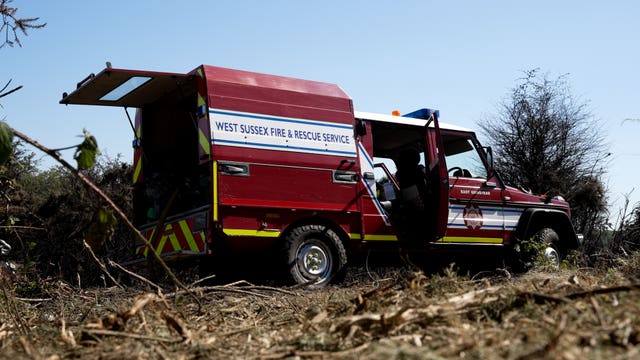
As of Thursday, there were 12 active wildfire incidents recorded on the National Resilience wildfire reporting system for England and Wales, down from 19 recorded on July 12.
An NFCC spokesperson said: “Fire and rescue services have been working tirelessly over the past two weeks, responding to a sustained period of intense wildfire activity while continuing to answer the thousands of other emergency calls their communities rely on every day.
“While the number of active incidents has started to fall, the challenge is far from over.
“As schools break up for the summer and more people head outdoors, we are asking everyone to play their part in reducing the risk of fire.”
The NFCC is calling on people to avoid using disposable barbecues where possible, dispose of cigarettes safely, and take litter home or use the bins provided.
“Parents and carers can also help by talking to children and young people about fire safety and the importance of respecting the outdoors,” the spokesperson added.
“Most wildfires are preventable. By making simple, responsible choices, we can all help protect our communities, wildlife, and natural spaces, while easing the pressure on firefighters who have already worked tirelessly to keep people safe this summer.”
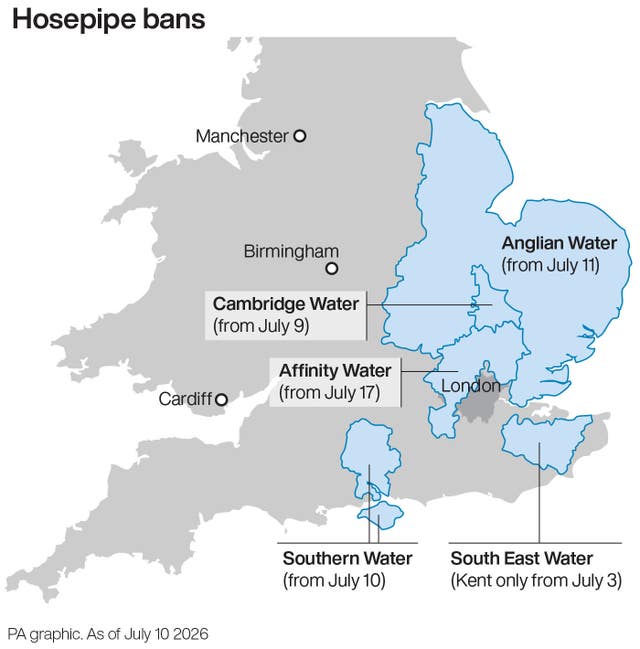
So far this summer, several hosepipe bans have been announced for large areas of southern England as strain on water supplies intensifies.
Reservoir storage levels in England are currently at 79%, around five percentage points below the long-term average for the time of year, the Environment Agency said as it released its weekly dry weather and drought report on Friday.
More sunshine this weekend though things turn a little cooler ☀️🌡️
More details here 👇 pic.twitter.com/KgaVG1LPm6
— Met Office (@metoffice) July 17, 2026
Six reservoirs are classed as having “notably low” levels, including Wimbleball in Somerset, Grafham in Cambridgeshire and Hanningfield in Essex, while Blagdon reservoir in Somerset is classed as being “exceptionally low”.
No areas of England are currently in drought, though the Environment Agency is “increasing its drought response activities” and the National Drought Group is scheduled to meet on July 20.
The report noted that “environmental incidents, such as those with dead fish due to dry weather and drought, are steadily increasing and wildfires are occurring around the country”.
The Met Office said it is too soon to say whether the heatwave conditions will last beyond the next 10 days and towards the end of July.
Britons have so far endured a sweltering summer of above-average temperatures and persistently warm nights.
England has been particularly warm, with mean temperatures currently 2.4C above the average 21C usually expected.
The Met Office said Wales is sitting 2.2C above an average of around 19.3C, and while Scotland and Northern Ireland have remained closer to their seasonal norms of 17.3C and 18.6C, they are still running above average at 0.9C and 1.3C respectively.